Contact
Log in
Book a demo

FLAG Emission Accounting in practise

Emma Valli

Marketing & Product Manager

Let’s start with the basics: what is FLAG emission accounting?

FLAG stands for Forest, Land & Agriculture.
FLAG emissions include greenhouse gases and removals associated with:

  • land use and land-use change
  • agricultural soils
  • biomass production
  • primary production practices

For food companies, these land-related emissions often form a significant share of the total climate impact. FLAG emission accounting makes these emissions visible and ensures they are calculated according to GHG Protocol and SBTi guidance.

Why FLAG accounting matter?

Traditional Scope 1–3 calculations mainly capture fossil emissions (energy use, transport, fuels, processing). FLAG complements this by adding the agricultural and land-use perspective, which is critical for food-sector accuracy.

FLAG accounting offers:

  • A more complete climate footprint by including land-based emissions
  • Transparency for customers, retailers and stakeholders requesting FLAG data
  • Readiness for SBTi FLAG target setting, which many companies are now expected to align with
  • Strategic insight into where raw material emissions come from and where reductions are possible

Because land use and agriculture are major global emission sources, FLAG helps companies understand their true climate profile.

How FLAG accounting works

FLAG calculations typically build on the company’s existing Scope 1–3 inventory. In addition, FLAG requires more specific information about:

  • country of origin of raw materials, and
  • agricultural production practices behind them.

The data does not need to be perfect from day one. Many companies start with the largest FLAG emission sources, and expand the detail level over time.

FLAG assessments often use a 20-year time horizon, especially for land-use change, because impacts such as forest conversion occur over long periods.

FLAG vs. Energy & Industry (E/I)

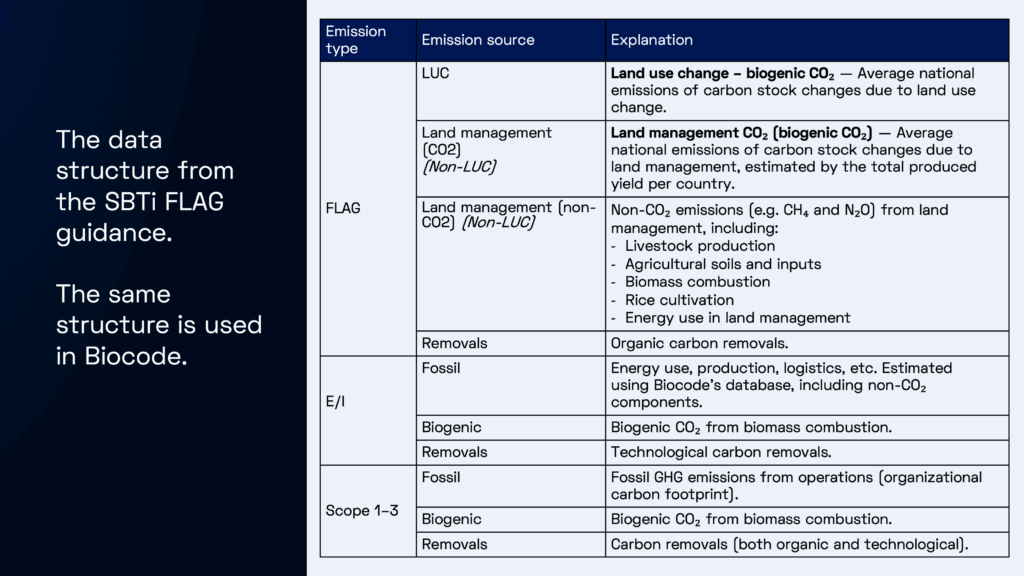
Biocode’s approach separates emissions into two groups, accordingly with the GHG Protocols Land Sector & Removals guidelines (draft version available on December 2025):

Energy & Industry (E/I)

Covers traditional Scope 1–3 emissions, such as:

  • energy use
  • logistics
  • processing
  • fuel combustion
  • electricity

These are largely fossil emissions and biogenic emissions from biomass combustion.

FLAG

Includes land-related emissions and removals from:

  • Land Use Change (LUC)
  • Land Management CO₂
  • Land Management non-CO₂ (CH₄, N₂O)
  • FLAG removals

This separation prevents double counting and provides a clearer, more science-based result.

For example:

  • The baking process or freezing of a pastry belongs to E/I,
  • but the emissions from growing wheat for the pastry belong to FLAG.

Getting started with FLAG emission accountig

FLAG accounting is easiest when built on top of an existing Scope 1–3 inventory. In the webinar recording above, Elina Ranta describes a simple, structured process:

  1. Start with a verified Scope 1–3 calculation
  2. Collect raw material origin information (country or region)
  3. Choose the appropriate accuracy level — typically starting with the top emission drivers
  4. Use Biocode’s FLAG calculator to convert Scope results into FLAG categories with one click
  5. Review EI and FLAG breakdowns, identify the main sources, and prepare reporting or target setting

Biocode’s team can also model individual agricultural ingredients or complex food products if they are not yet in the database.

Why adopt FLAG accounting now?

Companies that calculates their FLAG emissions gain:

  • A more accurate overall GHG overview
  • Credibility and transparency in sustainability communication
  • Compliance readiness for setting SBTi Targets in FLAG related industries
  • A competitive edge in value chains where FLAG reporting is increasingly requested
  • Better understanding of supply-chain risks and opportunities

FLAG emission accounting helps food companies look beyond operational emissions and address the real climate impact of their raw materials and land footprint.

See how Biocode is used for your company

What can you expect from a demo with Elina?

  • Question
    Expert assessment of your company's needs and current situation
  • Checkcircle
    Demo of Biocode’s product and services
  • Co2
    Case studies from our food industry projects
  • User
    Requirements for reliable calculation tailored to your needs
  • Chartline
    Calculation integrations and automation

Related posts

Webinars — Sep 02, 2024

Best Practices for Calculating Scope 1-3 Emissions in the Food Industry 

Regenerative farming
Webinars — Aug 12, 2024

Agricultural Greenhouse Gas Emissions and Their Management: Challenges and Solutions

Stay tuned and subscribe to our messages about the climate, food industry and food supply chain


    Biocode is committed to protecting and respecting your privacy. By filling out the form, you give Biocode permission to process your personal data in accordance with the Privacy Policy.


    Iconboxmail