News — Dec 17, 2025


Biocode has introduced a range of new features across its calculators to make sustainability accounting more accurate, efficient, and easier to integrate into everyday business operations.
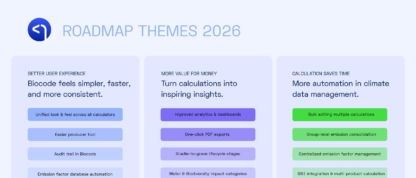
These updates are part of a broader product development effort designed to help companies move from manual data handling toward more automated, data-driven sustainability management.
One key development is the expansion of primary production integrations, enabling companies to connect upstream value chain data directly to their calculations and gain a more comprehensive understanding of the climate impacts of their products.
Biocode’s food product carbon footprint calculator now includes a new feature that significantly improves calculation accuracy.
Users can now apply custom emission factors, such as supplier-specific data, directly within the calculation. This allows companies to base their product carbon footprint calculations on supply chain–specific information instead of relying solely on generic averages.
This update is particularly valuable for companies that want to:
Biocode has also introduced a PDF reporting feature that makes sharing calculation results easier.
With a single click, users can generate a clear, well-structured report from a completed calculation. The report is designed to support:
All key calculation results are presented in an easy-to-understand format, making it simple to communicate climate impact data across teams and stakeholders.
Biocode now leverages AI to support Scope 1–3 emissions calculations and SBTi FLAG accounting.
Companies can import Excel datasets directly into the platform, after which Biocode automatically generates the emissions calculation. Results can also be exported back to Excel, making it easy to compare consumption data and emissions across different years.
At the same time, the platform introduces more flexible ways to analyse and manage emissions data. New capabilities include:
Together, these updates take sustainability accounting to the next level. The direction is clear: from manual data handling to automation, and from isolated datasets to a full value chain view.
Biocode’s mission is to provide companies with tools that make climate impact measurement reliable, transparent, and genuinely actionable for business development.